Ecumenical Patriarchate
Archdiocese of Thyateira and Great Britain
The Orthodox Church of St. Cosmas & St. Damian
Ipswich Suffolk


British and Irish Saints
(Including saints having a connection with these lands)
"When the Church in the British Isles begins to venerate her own saints, then the Church there will grow" – St Arsenios of Paros. (1877)
APRIL
1st St Agilbert, Bishop of Dorchester & Paris (690).
St Bede tells us what we know about St Agilbert. Probably born in France, he was ordained bishop and then came to England. Bede says he studied in Ireland and was appointed Bishop of the West Saxons with his see based in Dorchester. He then travelled north to Northumbria, ordained Wilfrid (who became Bishop of York), and attended the Synod of Whitby on the side of the Roman party. He later returned to France and became Bishop of Paris.
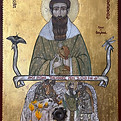
9th Hieromartyr Theodore, Abbot of Crowland (870).
Nothing is recorded about the life of St Theodore save as to his martyrdom. The year 870 saw a ferocious attack on East Anglia by the Danes who slaughtered many monastics in the region. They arrived at Crowland Abbey at the end of August 870. The liturgy was being celebrated in the Abbey Church when the Danes entered and slew as many monks as they could, including Theodore and many of those with him. Some monks managed to escape and flee into the nearby woods.
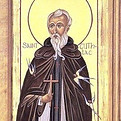
11th St Guthlac, Hermit of Crowland (714).
We know much about St Guthlac because of a biography written circa 730-740 by the monk Felix. It describes how the youthful Guthlac won fame at the head of a Mercian warrior band fighting the British on the borders of Wales before entering the monastery at Repton at the age of twenty-four. Distinguished from the first by his piety and asceticism, Guthlac moved on circa 700 to a solitary life on Crowland, an uninhabited island accessible only by boat deep in the wild and desolate marshland separating Mercia and East Anglia. Here he built a shelter cut into the side of a burial-mound in which he lived austerely, skin-clad in the manner of the Desert Fathers, for the rest of his life. Tormented by demons but consoled by visions of angels, Guthlac gained a reputation for sanctity and miraculous healing which spread far afield and continued to grow after his death.
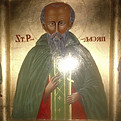
15th St Padarn of Wales, Bishop and Founder of Llanbadarn Fawr (5th-6th).
Whilst his origins are uncertain, Padarn did go to Ireland, and thence to Wales where he founded a monastery at Llanbadarn Fawr where he became bishop. It is said he went on pilgrimage to Rome and to Jerusalem.
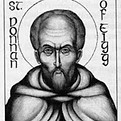
17th St Donnan, Monk-Martyr of Eigg (c 617).
The Isle of Eigg is a small, remote island off the west coast of Scotland (the Inner Hebrides) of just 30 km² which today has about one hundred inhabitants. The first record of human habitation is the arrival there of St Donnan circa 600, and who is the island’s patron saint. He was probably from Ireland and laboured to convert the Picts of western Scotland to the faith. He attracted some men to the island and Donnan formed a small community there. Little else is known save that he and his brethren were martyred by marauders from the sea, probably Vikings.
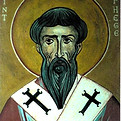
19th Hieromartyr Alphege, Archbishop of Canterbury (1012).
He became a monk in the Deerhurst Monastery in Gloucester, West of England, asking after a few years to become a hermit. He received permission for this vocation and retired to a small hut in Somerset. In 984 Alphege assumed the role of Abbot of the Abbey of Bath, founded by St Dunstan and by his own efforts. Many of his disciples from Somerset joined him in Bath. In that same year, Alphege succeeded Ethelwold as Bishop of Winchester. He served there for two decades, famed for his care of the poor and for his own austere life. King Aethelred made use of his abilities in 994, by sending him to mediate with the invading Danes. The Danish chieftain Anlaf converted to Christianity as a result of his meetings with Alphege. In 1005 Alphege became the successor to Aleric as the Archbishop of Canterbury, receiving the pallium from Pope John XVIII. He returned to England but was captured by the Danes pillaging the southern regions. The Danes besieged Canterbury and took Alphege captive. The ransom for his release was about three thousand pounds, but Alphege refused to give the Danes that much, an act which infuriated them. He was hit with an axe and then beaten to death.
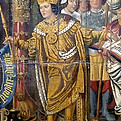
20th St Caedwalla, King of the West Saxons (689).
He became King of the West Saxons in 685. He made Kent and Surrey dependencies and wiped out the pagan people of the Isle of Wight. Despite being a pagan, he elected to give three hundred hides of land on the Isle of Wight to St Wilfrid and vowed to give a proportion of his war spoils to Christ. After a couple of years, he abdicated in order to become a Christian and travelled to Rome to be baptised by Pope Sergius on the eve of Easter, taking the baptismal name, Peter. It is said that his prayer was that Christ would release him from this temporal world and soon afterwards he died aged 31, still wearing his baptismal robes. He was buried in St Peter’s.
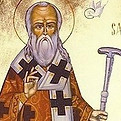
21st St Bueno, Abbot of Clynnog (c 640).
He was born in Wales and is thought to have been the uncle of St Winefride, being her spiritual guide in her early years. He was an effective preacher and evangelised much of North Wales. He also founded several monasteries, the principal one being at Clynnog Fawr. It was here that he died. Many miracles are reported to have taken place at his tomb. He is thought to be one of the most important saints of north Wales.
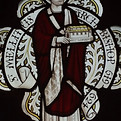
24th St Mellitus, Archbishop of Canterbury (624).
He was an Italian Abbot from Rome whom Pope Gregory sent as part of his second mission to England. St Mellitus brought with him instructions from Pope Gregory that pagan temples were not to be destroyed but put to Christian use. He was made Bishop of the East Saxons with his see centred on St Paul’s. Having later returned to Rome, he was recalled by Lawrence, Archbishop of Canterbury whom he succeeded in 619. According to Bede, that same year, he saved the Canterbury churches, as well as much of the city, from destruction by fire through the power of his holy prayers. Despite ill health he ruled well, and actively, until his death.

24th St Egbert of Lindisfarne (729).
He was the son of a Northumbrian noble family. He entered the monastery on Lindisfarne. Whilst studying at a monastery in Ireland, he, and his friend caught the plague. Sadly, his friend, Aethelhun, died. On recovery, Egbert was ordained a priest and gathered monks around him, with the intention of going to serve in Friesland. In a vision he was instructed, instead, to go to Iona. There he lived for the last thirteen years of his life, persuading the community to accept Roman practices.

28th St Cronan, Abbot of Roscrea (7th).
He was born in central southern Ireland, and founded Roscrea Abbey, where he also established a school. He instructed one of his monks to write the Dimma Gospel Book which is now in the Library of Trinity College, Dublin.
%2C%20Virgin%20Cornwall%206th.jpg)
29th St Endellion (Endelienta), Virgin (Cornwall) (?6th).
She is believed to have been the daughter of King Brychan of south Wales. Her siblings had already moved to north Cornwall to evangelize the people there, and Endellion went to join them. St Nectan of Hartland was her brother. There is a village named after her, and several churches. There are music festivals held every Easter and summer in the church at St Endellion.
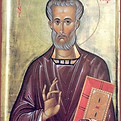
29th St Wilfrid of York (744).
Whilst a monk he received training under Abbess Hilda at the monastery in Whitby. Later Wilfrid became chaplain and close aid to John of Beverley when the latter was Bishop of York. When John decided to retire to the monastery at Beverley he consecrated Wilfrid as bishop in his stead. St Wilfrid was a faithful teacher and generous to the poor. He decided to retire early to Ripon Abbey to spend his remaining twelve years in prayer and worship of God.
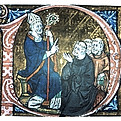
30th St Erconwald, Bishop of London (c 693).
As monk and bishop he was renowned for his holiness of life. He founded two monasteries, one at Chertsey in Surrey, and one at Barking in Essex near London. He was Abbot of Chertsey, and his sister was Abbess of Barking which was a women’s house. King Sebbi and St Theodore of Tarsus, Archbishop of Canterbury appointed him to the Bishopric of London. After eleven years as Bishop of London, he retired to Barking Abbey.